
Grand Island Resident Lookup Records
A single name may appear in several Grand Island record systems, but each answers a narrower question. The Town assessment search and the 2025 roll identify an assessed owner, parcel, property location, mailing field, and tax details. Erie County GIS adds map context and the SBL or PIN parcel identifier. The voter tool is a one-person registration match. Court and deed indexes place a name in a proceeding or recorded instrument. Vital, business, and license sources have their own access rules.
| Record | What It Can Confirm | Grand Island Route | Access Limit |
|---|---|---|---|
| Assessment roll and parcel search | Assessed owner, situs, mailing field, SBL, and dated parcel facts | Town Assessor and the linked assessment search | Public, but owner mail is not occupancy proof |
| Recorded instruments | Grantor, grantee, date, legal description, and book or page | Erie County Clerk BrowserView | Land index is generally online from 1986; older routes differ |
| Voter registration | A matching registration and poll-related result | New York Voter Lookup | County, first name, last name, birth date, and ZIP are required |
| Local civil docket | Party role, case number, court, type, and status | WebCivil Local | Sealed and protected matters are absent |
| Vital record request | Eligible relationship, death, birth, or marriage facts | New York State Department of Health | Eligibility and confidentiality rules control copies |
Use the address route first when the goal is to distinguish a current assessed owner from another person with the same name. Use a court number, filing year, and court when the question is about a case. For an older family question, a directory, obituary, deed, or eligible vital-record route can provide a dated link instead of a claim about the present.
Confirming a Grand Island Resident
Begin a Grand Island resident lookup with the full name, common variants, an approximate era, and a target address or parcel. The assessment roll separates “Property Location & Class” from “Current Owner Address.” The first is the situs, meaning the property itself. The second is a mailing field. They can match, but they do not have to. Save the SBL or PIN and the assessment date before comparing a name elsewhere.
Erie On-Map is a second custodian for the parcel. Its public viewer can search by address, owner, or SBL and show map layers, parcel dimensions, and owner or mailing fields. The parcel data is described as as-is, extends through 2025 after the January 2026 update notice, and is not a survey. That makes it useful for matching the right land, not for deciding who is inside a home.
Insider tip. Keep the situs, mailing address, SBL, and source date in separate notes. Combining them into one “address” is how a tax contact becomes an unsupported residence claim.
Note: An exemption or a repeated owner name is a tax-roll detail, not evidence of every person connected to a Grand Island parcel.
Grand Island Voter Match Rules
The state voter tool is designed to match a named person, not to create a broad Grand Island address list. Select Erie County and enter the voter’s first name, last name, date of birth, and ZIP code. A successful result concerns registration, poll-site, or related election information. It does not reveal ballot choices, and it should not be presented as proof of ownership or current household membership.
For a lawful record request, the New York Board of Elections requires an elections-purpose statement. Erie County’s form lets a requester choose a T/W/D geography, format, data elements, and sorting method. Use the smallest lawful area and only the fields needed. Confidential registrations under Election Law §5-508 are maintained separately and are not available for ordinary inspection.
Grand Island Court Index Details
WebCivil Local can be a useful Grand Island resident lookup cross-check when a name is already tied to an address, era, or other independent detail. It offers party, attorney, judge, case or index number, court, case type, filing year, status, future-appearance, sorting, and HTML or PDF output choices. Search by a precise case number where possible. With a name alone, compare middle initials, town, party role, and dates before treating a result as the same person.
PACER’s national case locator is the federal route when the likely matter belongs in federal court. Its national search is updated daily, while a specific court’s data is real time. Access requires an account and has its own current fee schedule. A federal name hit also needs a court, case number, case type, and date check.
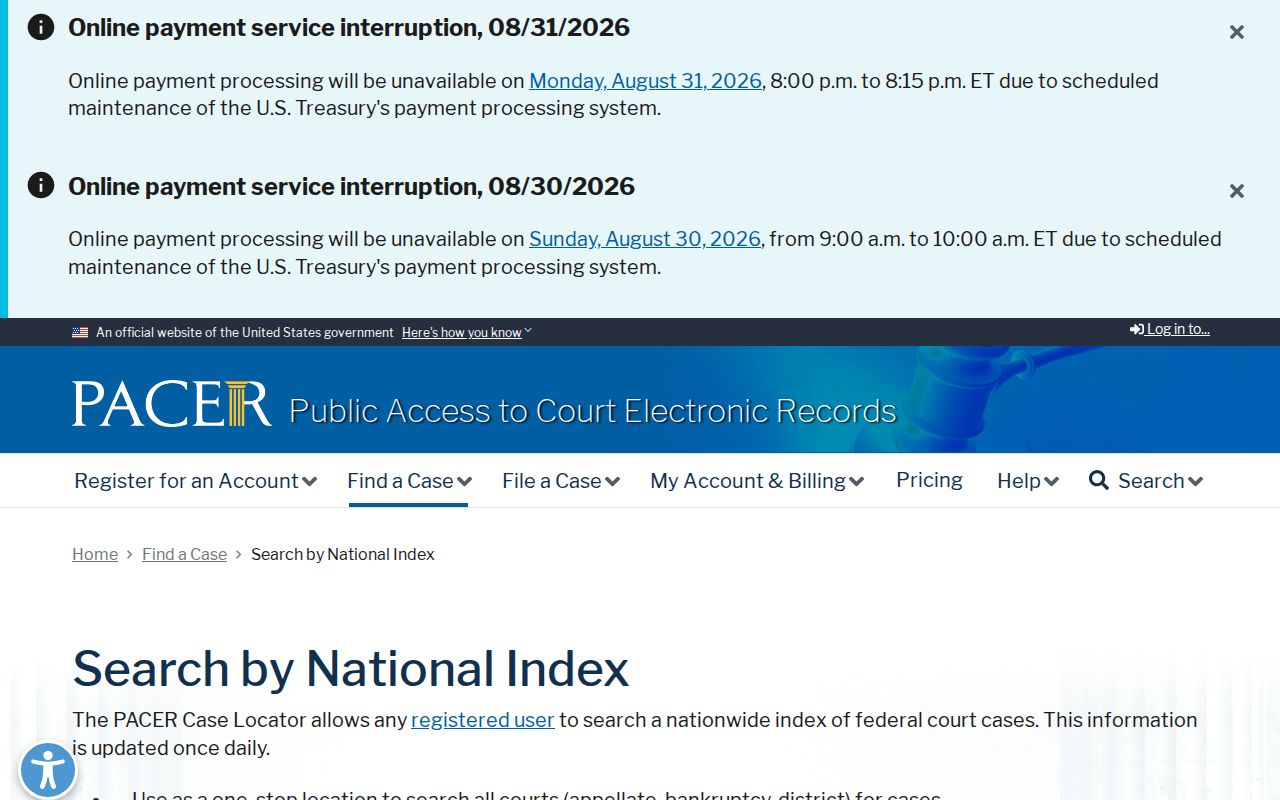
The PACER screen reinforces why a name alone is not enough. Record the court and case identifier beside the person’s name, then seek the file or docket from the proper custodian when the result matters.
| WebCivil result field | What to save |
|---|---|
| Identity fields | Indexed party name, party role, attorney or firm, and judge where shown |
| Case placement | Court, case or index number, case type, and filing year |
| Status context | Open or status indicator, future appearance, and calendar information |
| Document limit | Whether the result is only an index entry or leads to a court-specific file |
Grand Island Town Court is at 2255 Baseline Road, second floor, and lists weekday hours of 8:30 a.m. to 4:30 p.m. at 716-773-9600 extension 650. For a local copy request, give the clerk the party, case number if known, filing or appearance date, and record type. The public web result is not necessarily the full file or a certified disposition.
Grand Island Vital and Probate Routes
Vital records are not a public resident list. The Grand Island Town Clerk is the local registrar for local birth, death, and marriage material, while the Department of Health handles statewide routes outside New York City. For genealogy, the state says a birth record is generally available after 75 years when the person is known deceased, a marriage record after 50 years when both spouses are known deceased, and a death record after 50 years. Direct-line requests can require relationship and death proof.
The Department of Health genealogy route uses form DOH-4384. Its base fee is $22 for a one-to-three-year search, and the Department warns that processing can take eight months or longer. Mail requests go through the state form. For a recent or locally held record, call the Town Clerk before visiting with names, date and place, relationship, and identification. FOIL does not replace the eligibility process.
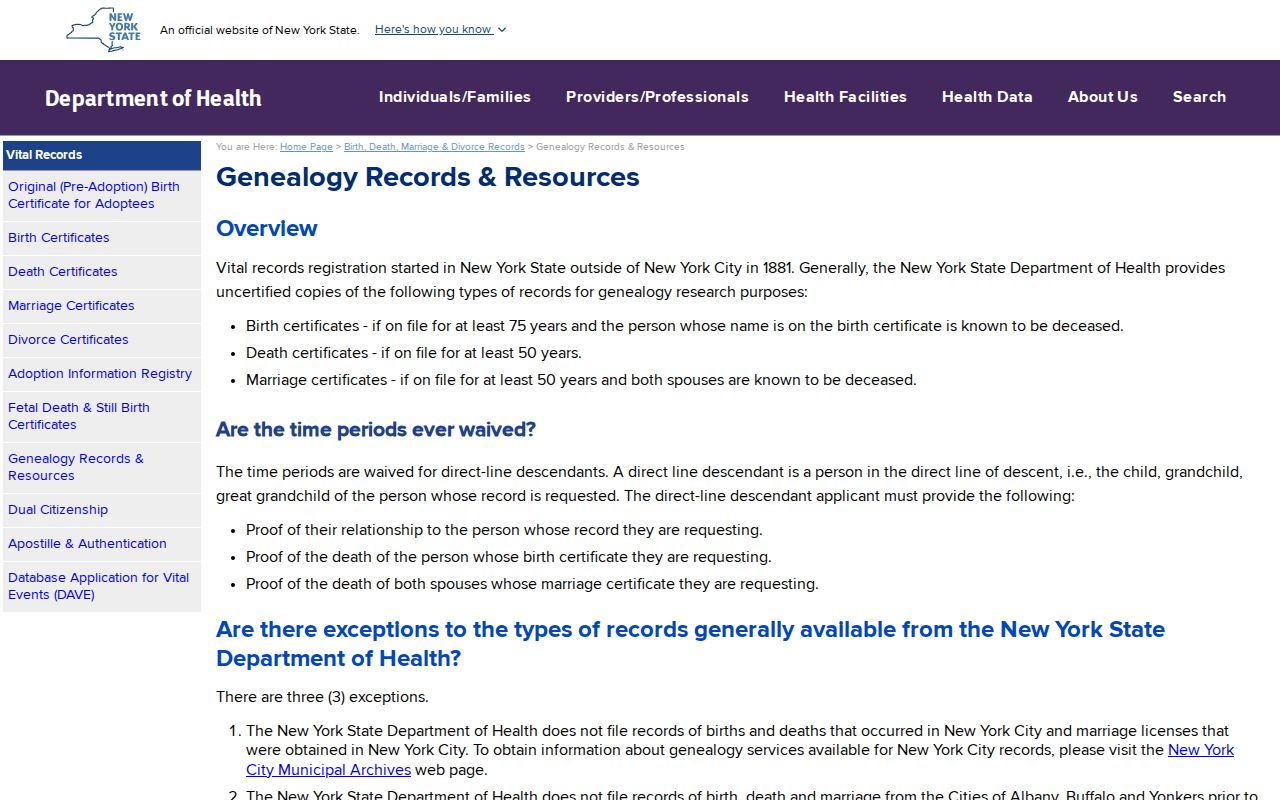
The state eligibility screen is a reminder to choose the right route before requesting a copy. A genealogy copy is uncertified and is not the same as a current certified record.
For estate work, WebSurrogate provides online documents generally filed on or after February 19, 2014. Older Erie materials are available through the Public Access Room at the courthouse, so an absent online document can be a date limitation. Adoption records remain confidential; the official Adoption Information Registry and intermediary process is the lawful path for reunion or nonidentifying information.
Grand Island Resident Lookup Verification
Verification means testing the same identity with separate custodians. It is not adding every available name hit to a file. A deed party and voter match, a court index and business filing, or a directory and dated obituary can be useful combinations when the address, middle initial, spouse or co-grantor, town, and dates line up. Stop if the overlap is weak.
- Write the full name, initials or prior surname variants, a likely era, and the target Grand Island address.
- Use the assessment roll or GIS to save the parcel’s situs, SBL or PIN, owner field, and source date. Do not treat the mailing field as a residence finding.
- Check an independent custodian, such as the Clerk’s deed index, Voter Lookup with the required match fields, or a court index with an exact case clue.
- Compare middle initial, spouse or co-grantor, town, street, and time. For a court hit, record the case number, court, filing year, party role, and case type.
- Request an image, disposition, or certified copy only from the office that holds it when a formal record is needed.
- Docket
- A court’s running case record, often showing filings, events, parties, and status rather than every document.
- Index versus image
- An index points to a filing or record. The image is the document itself and may have a different online, office, or copy route.
- Certified copy
- A copy issued and authenticated by the custodian for an authorized purpose. It is not created by a search result.
Note: A negative name search can reflect spelling, date coverage, a protected record, or the wrong custodian rather than a person’s absence.
Grand Island Affiliation Records
Public filings can confirm an affiliation, not a home. The New York Department of State business inquiry can return entity name, organization date, jurisdiction, county, service-of-process address, agent, and status. Erie County assumed-name records and state licensing searches can add a date or credential. Compare those facts with an independent source and preserve the filing date.
A service address, registered agent, officer listing, or license record may belong to an organization or professional role rather than a person’s residence. Use these sources to separate same-named people or confirm a public connection, not to fill in a household profile.
Grand Island Records Beyond the Web
When a Grand Island resident lookup ends online, take the identifier to the office that owns the record. Erie County deed records start in 1808, although the land index is generally online from 1986. Older books, the Graves Index, Clerk terminals, document requests, and mail routes can fill a dated gap. The Clerk’s official request procedures are better than assuming an unavailable image means there was no instrument.
New York Freedom of Information Law, Public Officers Law Article 6, §§84-90, creates a request route for public agency records. It does not open sealed court files, vital records, confidential voter registration, or protected addresses. A precise request identifies the record type, date, parcel, case number, or other reference and lets the custodian apply the correct law.
For historical identity questions, the Buffalo & Erie County Public Library’s genealogy collections, newspapers, directories, and census resources can establish dated context. A former household trail belongs in the Grand Island past residents records, where the parcel history and historical collections take the lead.
Grand Island Resident Lookup Limits
New York’s privacy rules set real boundaries. The Address Confidentiality Program uses a substitute address for eligible participants, and confidential voter registration under Election Law §5-508 is not open for ordinary inspection. Motor-vehicle personal information is restricted by the Driver’s Privacy Protection Act, 18 U.S.C. §2721 et seq. Utility, delivery, and private association records are not general public sources. Do not try to work around a record that has been withheld.
For an error, go to the source custodian: the Town Assessor for a roll issue, Erie GIS for parcel data, the Clerk for indexing, the court clerk for docket information, the Board of Elections for voter status, and the Department of Health for vital-record corrections. A private commercial listing can be stale or merge people with the same name, so it is never a final identity finding.
Lawful use. Use Grand Island records for personal, lawful research, family history, estate questions, or confirming a public filing. Never use a result to stalk, harass, intimidate, or expose a protected person.