
Grand Island Previous Resident Sources
A past-household search has two tracks. The ownership track begins with the current parcel and recorded deeds. The household track uses dated directory, census, newspaper, and obituary evidence to identify who may have lived there. They often overlap, but a deed names parties to a transaction while a directory records a publisher's view of an address in one edition. Keep those claims separate.
Start with the source that is nearest to the period in question, then work back one document or one available edition at a time. The table identifies documented access routes and limits. It does not turn an owner name, tax mailing address, or one old listing into proof of current occupancy.
| Source | Years it covers | Where held | What it shows |
|---|---|---|---|
| Erie County deeds | 1808-present | Erie County Clerk | Recorded parties, dates, consideration, and legal description |
| Online land index | Generally 1986-present | Clerk BrowserView | Party, document, book/page, map or parcel details when indexed |
| Deed images | Generally from 1960 | Clerk access routes | Document-level text subject to access limits |
| Printed directories | Scattered local and regional years | BECPL and related collections | Dated address and household clues |
| Historical census material | 1850, 1855, 1860, 1865, 1870, 1875, 1880, 1892, 1905, 1915, 1925 | Clerk genealogy material and library routes | Household context for a census year |
| Building and code files | No verified public online run | Town Building/Code or FOIL request | Parcel-related application or inspection clues |
For house history, this sequence is more reliable than searching an address as if every record used the same index. The Clerk's official record search does not search by street address, so the parcel information is the bridge into the deed system.
Grand Island Previous Resident Parcel
Before pursuing this address history, establish the situs parcel. The Town assessment route, static assessment roll, and Erie County On-Map can supply the property location, SBL or PIN, and sometimes a deed book/page. A current owner mailing address is not the same thing as the property location, and neither field is a household roster. Treat the parcel identifier as the durable anchor when street wording changes.
Erie County On-Map supports address, owner, and SBL parcel searches, parcel identification, and map layers. If the assessment link is needed, the Grand Island Town Assessor page identifies the local office and its linked assessment system. Record the property location, SBL/PIN, current deed reference if shown, and the date on the source before moving to the Clerk.
Insider tip. The dated assessment roll can put the SBL, property location, owner mailing field, and deed book/page in one place for the first pivot.
Grand Island Previous Resident Clerk Index
BrowserView is a party, document, map-number, and date tool rather than an address lookup. After collecting the SBL or deed book/page, search by map number or parcel ID when available. The party-name field expects last name first name with no comma. Town, document type, consideration amount, and from/to dates can narrow a broad result, but a name match still needs to be compared with the parcel and document date.
| Map Number / Parcel ID | Use the parcel anchor where it appears in the record system; date ranges may be added. |
|---|---|
| Party Name | Enter last name first name without a comma and repeat searches for spelling variants. |
| Document Type | Use the available code or category to narrow the result to the instrument being pursued. |
| Town and dates | Select Town and supply a from/to range when the transfer period is known. |
| Result details | Capture parties, type, recording date, book/page or instrument number, consideration, and any verification status. |
The official Erie County Clerk BrowserView records search fields and result layers. Its results are not a title opinion. Compare spouse or co-grantor, legal description, parcel reference, and dates before connecting the next person to the same Grand Island Town property.
Grand Island Previous Resident Graves Index
Older transfers require a different route. Although Erie County deeds are a series from 1808 forward, the online land index generally begins in 1986 and deed images are generally available from 1960. For deeds from 1960 through 1985, the Clerk directs researchers to the alphabetical Graves Index and then to a Liber or book-and-page route, using the owner name as needed.
When the online view stops, do not assume the chain stops. The Clerk's public basement terminals at 92 Franklin Street in Buffalo, older book or microfilm access, and a records request are the documented next steps. The Erie County Clerk records page explains the coverage split across deeds, indexes, and images.
Grand Island Previous Resident Deed Trail
A chain of title is built one link at a time. Begin with the current parcel's recorded deed, identify the grantee and grantor, then use the earlier party and citation to locate the prior transfer. The legal description and prior-deed citation are usually more durable than a street address because older documents can use island, hamlet, or boundary language rather than modern address formatting.
- Use the Town assessment roll, assessment route, or GIS to record the situs address, SBL/PIN, and any deed book/page.
- Find the current transfer in BrowserView by book/page, parcel or map number, party, town, document type, and date.
- Record grantor, grantee, instrument or book/page, recording date, consideration, legal description, and any cited prior deed.
- Search the seller as a grantee to find that person's earlier acquisition, then repeat the comparison backward.
- For older or unavailable images, use the Graves Index, Liber/book-page route, basement terminals, or an official request.
- Grantor / grantee
- The grantor transfers an interest in the document; the grantee receives it. Their roles can change in another transaction.
- Chain of title
- The sequence of recorded transfers for the same parcel, checked by parties, dates, descriptions, and prior citations.
- Legal description
- The parcel description used in the deed. It helps connect older documents when the street address is absent or expressed differently.
- Criss-cross directory
- A directory section arranged by street and house number that can give a dated occupant clue but does not prove title.
- Enumeration district
- The geographic area assigned for a census count, useful when locating the correct schedule or neighborhood context.
Grand Island Previous Resident Deed Evidence
A recorded deed can document a transaction, its parties, date, consideration when present, legal description, and prior-record reference. It cannot by itself prove that the grantee lived at the property, that every resident was named, or that the first similar party name in the index is the same person. Compare the deed with the parcel, spouse or co-grantor, and a second dated source before calling it part of the same history.
Use the Clerk's online request form when a copy or search is needed and the book/page, index number, date, names, or locality can be supplied. The office says it will contact a requester within two business days; copying, search, postage, and convenience charges may apply, so no fixed amount should be assumed. The Erie County Clerk document request form accepts details that make an older record easier to locate.
The following New York State Archives Historical Documents Inventory image points to archival repositories and record holdings that may help with older research.
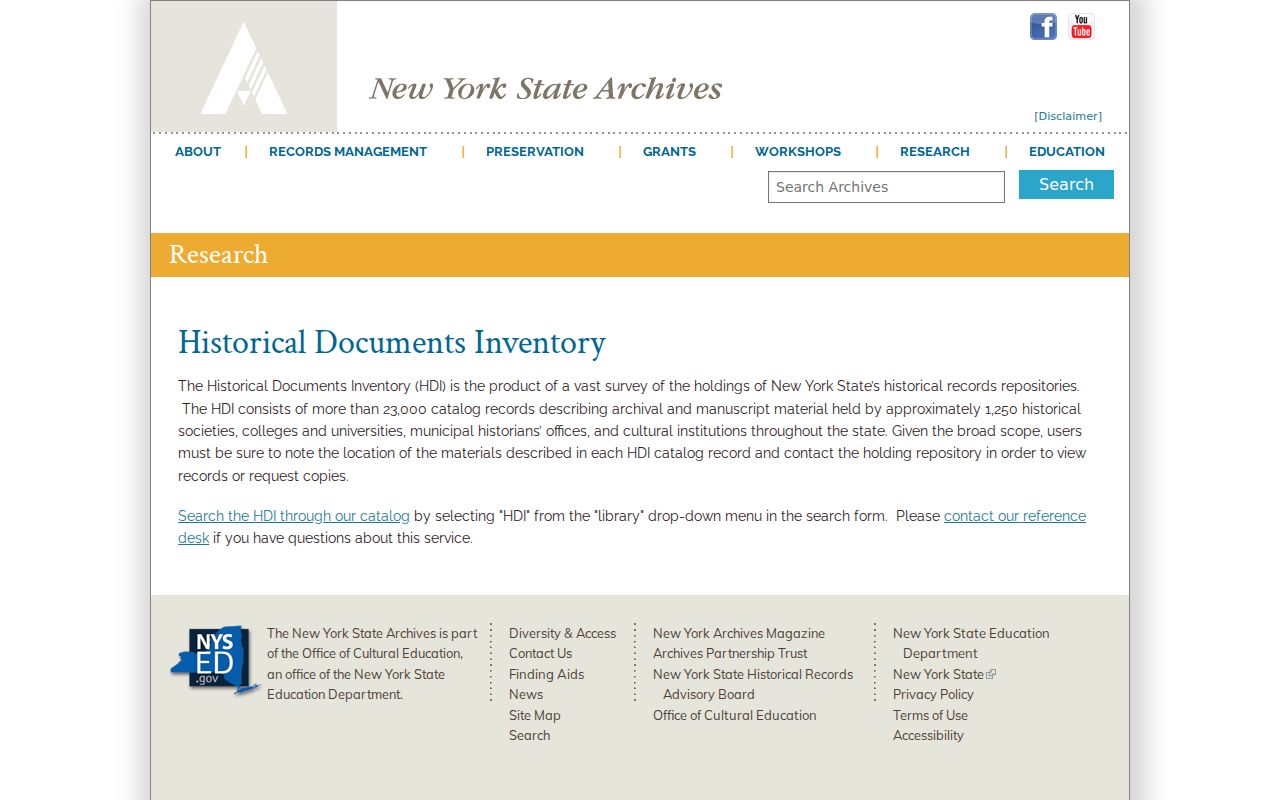
The inventory is a repository finder, not a household database. Use it to identify a possible custodian, then ask that repository about the specific series, date range, access rules, and copy process.
Grand Island Previous Resident Household Timeline
Deeds follow owners, but past residents can include people not named in a transfer. Pair the deed timeline with an address-side directory entry, the alphabetic name section, and the closest available census year. The Grand Island volumes are scattered rather than continuous, so note the exact edition and treat each entry as a dated observation. The Grand Island Town city directory collections page covers the local shelf, call numbers, and reading method in detail.
- Write the house number, street, locality form, and SBL from the parcel and deed record.
- Search the same address in a reverse or criss-cross directory and then search the occupant in the alphabetic section.
- Compare the closest available directory editions rather than inventing a year between published volumes.
- Match the interval to the available census sequence: 1850, 1855, 1860, 1865, 1870, 1875, 1880, 1892, 1905, 1915, or 1925.
- Use newspaper notices, an obituary, assessment information, or probate material as an independent final check.
The Buffalo & Erie County Public Library's genealogy guide lists onsite and library-database routes for census material, city directories, newspapers, and regional reference works. A directory listing can bridge a deed and a census, but it cannot establish every person in a household.
Lawful use. Grand Island Town previous-resident research is for house history, family history, estate questions, and personal curiosity. Do not use it to stalk, harass, or harm a living person.
Grand Island Previous Resident Building Files
Town Building, Code Enforcement & Zoning files can place a named applicant, owner, permit, inspection, or code event at a parcel during a particular period. They are supporting time markers, not a resident list. The department covers permits, plans, inspections, and code matters, but research did not locate a public online permit or case database.
Request a narrow record by parcel, address, record type, and approximate date through the department or the Town's FOIL process. The Building, Code Enforcement & Zoning page identifies the office and its permit materials. Naming the parcel and time window makes a response more useful than a broad request for everyone who lived on a street.
Grand Island Previous Resident Place Names
Older island records may be indexed under the place words that were current when they were created. Grand Island Town formed in 1852, and early routes include East River, West River, Stony Point, and Baseline. Ferry Village, Grandyle Village, East River, and Whitehaven can also appear in local historical material. Preserve these forms in search notes instead of forcing each source into today's street style.
This is a useful house-history caution: no verified street-renumbering chronology was found. A similar road name or changed number is a lead to verify through the parcel description, deed citations, maps, and dated local material, not a shortcut for merging two properties or two families.